Evaluator Independence: Why Scores Should Stay Hidden Until the Round Is Locked
Independence is easy to claim and hard to show. This article explains anchoring, why seeing others' scores early is a protest vector, and what it means to enforce hidden-until-lock rather than ask for it.
Rovaryn Digital · October 20, 2026 · 9 min read
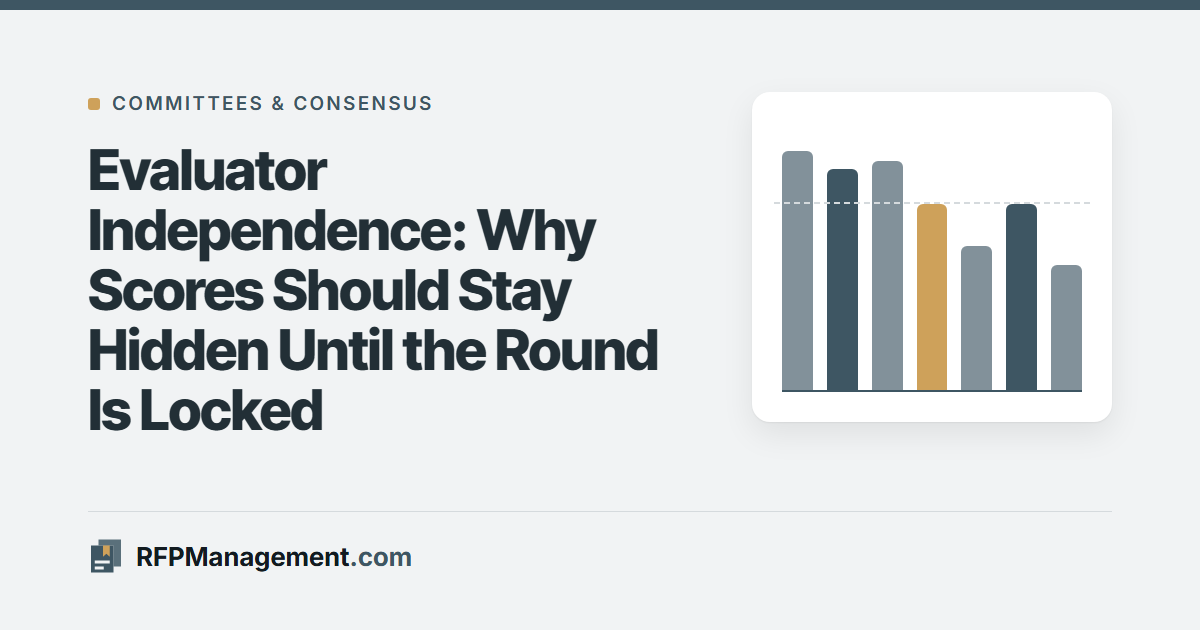
A scenario: scores that look too similar
A committee chair opens the shared scoring spreadsheet the morning after the deadline for evaluator scores. Five evaluators have rated four proposals on six criteria. Four of the five columns are nearly identical, down to the odd half-point on the staffing criterion. The fifth evaluator, a program director, scored the same proposals quite differently.
Nobody did anything obviously wrong. The file was in a shared folder, evaluators could open it any time, and one of them entered scores first. But a losing offeror who later asks for the evaluation record could reasonably ask whether the later scorers formed their own views or followed the first.
The chair now has to answer a question the spreadsheet cannot settle. This article explains why independent scoring matters, what anchoring looks like in a file, and what it means to enforce independence instead of requesting it. By the end you should be able to describe, and show on paper, how your evaluators scored alone before anyone compared notes.
What evaluator scoring independence means in an RFP
Evaluator scoring independence in an RFP means each evaluator forms and records a rating for each criterion without seeing any other evaluator's ratings. Discussion happens afterward, in a consensus step, and the individual scores remain on record as they were first entered.
The sequence matters. Individual scoring comes first, then a structured comparison, then a recorded final score with its rationale. If the order flips, so that people see others' numbers while still scoring, the individual scores stop being independent observations. They become partly a reaction to one another.
Federal rules do not use the phrase "scoring independence." They do set the frame the practice supports. Under 2 CFR 200.320(b)(2)(i), a request for proposals must identify all evaluation factors and their relative importance. Under 2 CFR 200.320(b)(2)(ii), an entity using the proposals method must have written procedures for conducting technical evaluations and making selections. An independent-scoring rule is a natural part of those written procedures. It describes how each evaluator applies the published factors before the group discusses them.
How anchoring shows up in evaluation files
Anchoring is the tendency to let the first number you see pull your own judgment toward it. In an evaluation, the first number is often a colleague's score, a verbal comment in the hallway, or a column of totals visible in a shared workbook.
We are not citing statistics on how often this happens or how large the effect is, because we do not publish an unsourced figure. The mechanism is easy to recognize without one. Common patterns in a file include:
- later evaluators' scores clustering tightly around an earlier evaluator's scores on the same criteria;
- one senior or vocal evaluator's scores matching the rest of the group closely while a quieter evaluator's differ;
- score changes recorded after a meeting, with no note of what was said;
- identical rounding habits, such as the same half-point increments, across people who did not confer.
None of these proves anything. A tight cluster can simply mean five careful people read the same strong proposal the same way. The problem is that the file cannot distinguish that innocent explanation from the other one. Independence that cannot be shown is, for record purposes, independence that is only claimed.
Evaluator bias is a different problem
Evaluator bias in RFP scoring covers personal preferences, familiarity with an offeror, or a leaning toward the incumbent. Anchoring is narrower: it is about the influence of other people's scores on yours. Independent scoring does not remove bias, but it keeps one evaluator's bias from spreading to the rest of the group, and it leaves the individual scores available to examine afterward.
Conflicts of interest are handled separately. Under 2 CFR 200.318(c), no employee, officer, agent or board member with a real or apparent conflict of interest may take part in the selection, award or administration of a contract supported by a federal award. A conflict attestation completed before scoring begins, which our piece on the evaluator conflict-of-interest form describes, handles that question. Independence handles a different one: whether the scores in the file reflect each person's own reading.
Why early visibility becomes a protest vector
When an offeror is not selected, it may ask how the evaluation was run. Local protest and debrief procedures vary and come from the issuer's own policy and state or local law, so check yours. Under 2 CFR 200.318(k), the recipient or subrecipient is responsible for settling the contractual and administrative issues arising out of its procurements. "These issues include, but are not limited to, source evaluation, protests, disputes, and claims." The issuer's own record is the main thing it has to rely on.
That record has to show more than a ranking. Under 2 CFR 200.318(i), the file must be detailed enough to show the history of the procurement, including the rationale for the method, the contract type, the selection or rejection of contractors, and the basis for the price. A set of final scores shows an outcome. A file that also shows that each evaluator scored alone, and when each score was submitted, shows how the outcome was reached.
For context only: the U.S. Government Accountability Office reports that the most frequent grounds on which it sustained protests in fiscal year 2025 were an unreasonable technical evaluation, an unreasonable cost or price evaluation and an unreasonable rejection of a proposal (GAO-26-900695, December 2025). Those figures describe federal agency procurements, not grant-recipient or local ones. They do show that evaluation records are where challenges tend to land. Our discussion of local protest procedure covers what to check in your own policy.
Early visibility creates an accusation that is hard to answer. If scores were visible while others were still scoring, the issuer has no clean way to say they were not looked at. Asking evaluators to be honest about it is a request. Making it technically impossible is a control.
Asking for independence versus enforcing it
Most small offices handle this the same way. The chair emails the evaluators, asks them to score on their own and not to share numbers, and collects the sheets. This is a reasonable first step, and it is what many committees do. The limit is structural, not a failing of any template or person.
In a shared spreadsheet, nothing technically prevents someone from opening another evaluator's tab. With emailed scoresheets, the chair sees scores as they arrive, and may mention a pattern in passing. Both setups rely on goodwill, and goodwill leaves nothing in the file to show afterward. Our guide to a scoring template in Excel explains what a spreadsheet can and cannot enforce.
A control, by contrast, works whether or not anyone is paying attention. For an evaluation record, the useful properties are:
- each evaluator can see only their own scoresheet while the round is open;
- submission is timestamped and recorded;
- the round closes at a defined moment and cannot be reopened silently;
- what each evaluator entered stays preserved after the group meets.
What hidden-until-lock means
RFPManagement is designed around this sequence. It is designed to keep each evaluator's scoresheet hidden at the database level until the round is locked. After the lock, which is designed to be irreversible, the individual scores become visible for the consensus step. Evaluators are to be invited by magic link, in a scoring or advisory role, and no score is designed to save until the evaluator has completed a conflict-of-interest attestation.
Two other features are designed to support the same purpose. The product is designed to flag large spreads in scores on a criterion, configurable and informational only, so the chair knows which items need discussion at consensus. It is also designed to require a written rationale for each final score in the consensus record. Scoring is human-only: the product is designed with no AI scoring or score suggestions, and nobody but the evaluators produces a rating.
Rovaryn Digital Inc. builds the software, so we can speak to how it is designed and what it computes, not to how any committee has used it. The product is designed to record and compute. It is not a substitute for your procedures, and the award decision stays with your organization.
Setting up an independent scoring round
Whether you use a spreadsheet, a workbook or software, the same few steps make independence easier to show. Many of these belong in your written evaluation procedures under 2 CFR 200.320(b)(2)(ii).
- Fix the criteria and rating definitions first. Weights and what each rating point means should be settled before any evaluator opens a proposal. Our overview of the evaluation committee covers who sets them.
- Collect conflict attestations before scoring. Record the date each one was completed.
- Name the order of operations. State in writing that individual scoring happens first, alone, and consensus happens after all scoresheets are in.
- Set a submission deadline and a lock. Decide who closes the round and how the closing is recorded.
- Keep the original scores. When consensus changes a score, record the new number, the reason and who agreed. Do not overwrite the individual entries.
- Hold the consensus meeting after the lock. The consensus scoring process works best when evaluators can see everyone's independent ratings for the first time together.
- Retain the file. Under 2 CFR 200.334, records are generally kept three years from the date the final financial report is submitted, unless an exception applies, and local public-records rules may require longer. Confirm your retention period with your awarding agency or pass-through entity.
State and local rules may be stricter than the federal ones. When both apply, follow the stricter one, and confirm how they apply to your award with your awarding agency, pass-through entity or counsel.
Next steps and a note on scope
If your committee works from spreadsheets today, the most useful first move is to write the order of operations into your procedures and keep a dated record of when each score arrived. That alone makes the file more informative.
For a structured version, the Evaluator Scoring and Consensus Workbook is designed to record individual scores, flag spreads and capture the consensus rationale for each criterion. It is available in the store now. To hear when the evaluation workspace opens, you can join the waitlist. Plans are described on the pricing page.
RFPManagement records and computes. It does not give legal or procurement advice. The award decision stays with your organization.
Ready to go beyond the guide?
Compare plans on the pricing page.
Get the guides
Related guides
The RFP Evaluation Committee: Roles, Size, Training and Ground Rules
A committee is only as defensible as its ground rules. This guide covers scoring and advisory roles, committee size, orientation and a calibration round, and what the chair should record before the first score.
Rovaryn Digital · October 20, 2026 · 12 min read
Consensus Scoring in RFP Evaluation: How It Works and What to Record
Consensus scoring replaces an average with an agreed score and a written reason. Here is how to run the meeting from the criteria with the widest spread and record a rationale for every final score.
Rovaryn Digital · October 20, 2026 · 11 min read
Evaluator Conflict of Interest Form for RFPs: What 2 CFR 200.318(c) Requires
Each evaluator's attestation belongs in the file before their first score. This guide covers what the form should ask, how 2 CFR 200.318(c)(1) frames conflicts, and how to record disclosures.
Rovaryn Digital · October 20, 2026 · 8 min read